
A Wednesday Links Dump
When I'm Too Lazy to Write a Real Post ...

Written while listening to Creedence Clearwater Revival Chronicles on vinyl.
Lots of interesting material has crossed my transom, and I’m too lazy to write a coherent post about any of them, so here are scattered thoughts about several of them:
I have lots of ides and opinions about pedagogy, especially in our AI era. Many of them are captured in this Chronicle of Higher Education piece. Foundationally I think it is perfectly ok for people who know things to teach the things they know to the people who do not know them. Lecturing is fine! Discussions are fine if students have done the reading or other work to ensure that they are actually discussing something! Tech tools for pedagogy are fine if the faculty member wants to use them, knows how to use them, are not being forced to use them, and if they are not being used as substitutes for actually teaching.
I get the argument that academics have not always been trained how to teach, though in many cases that is simply overblown. Anyone who served as a TA may not have learned pedagogy per se, but if they were paired with a good teacher, they were put in a perfect situation to learn about class construction. Furthermore, anyone who made it through a Ph.D. really needs to have learned how to model behavior of what worked from good faculty (and of what didn’t work). I had great models as an undergraduate and in my MA and PhD programs and took what worked for them that I thought might also work for me as I entered my own teaching career.
At his still-relatively-new joint Sean Jacobs republishes a 2018 reflection on Winnie Mandela’s life (and legacy) in response to a new Netflix series on her. She was a complicated figure for myriad reasons, but she sometimes got reduced to her excesses and to those of the Mandela United Football Club. And don’t get me wrong, some of those excesses are really damning. At the same time, as important as Nelson Mandela was, there were those on the ground while he was in prison, including Winnie, who had to face realities on the ground, realities that by the mid-1980s were unimaginably worse even than those in the early 1960s when Nelson Mandela went to prison. And Winnie Mandela had to do it while walking that line between her own activism and her status as a wife whose husband was the living martyr to the movement. It was never easy, especially when she faced myriad bannings, harassment, and abuse at the hands of the apartheid state. I appreciated this piece when Jacobs published it in the wake of Winnie’s death and I appreciate it perhaps even more now.
In March The Guardian published a photo essay on my Ph.D. alma mater Ohio University revealing the juxtaposition of a large, progressive university in the midst of a conservative rural community in Appalachia. (The little grocery store near my apartment on Union Street makes an appearance — there also is a house that looks an awful lot like my then-girlfriend’s student slum house). As is often the case in these scenarios, most people involved in campus life, certainly student life, are blithely unaware of the tensions inherent in these town-gown relations. The go-to line for students is usually something along the lines of “there is no Athens without the university.” (We also said something similarly snotty at Williams about Williamstown). And this is true for what it’s worth, but largely beside the point, as it’s not really worth that much — there is a university and there is an Athens and how the two interact matters. Faculty and especially staff tend to have a more measured view. Faculty are not in most cases planning to be short-term guests — they are going to be faculty at OU but residents of Athens. Staff are drawn in huge percentages from that local community, so their perspective is oftentimes even more valuable inasmuch as they may well not see the university as anything much more than any other employer. If the faculty and students are more of the university, the staff tend to be more of Athens. In any case, Go Bobcats!
A lot of my colleagues on the left are imagining that the FIFA Men’s World Cup, which kicks off next month, is going to be an absolute shit show. They envision visiting fans being harassed by ICE, people who spent thousands of dollars being turned away at airports, and people on the way out of the country having their electronics confiscated. They see entire teams having similar troubles.
I can certainly see that perspective. I also imagine that the dynamic will be subtler. Most visitors will go unmolested. Most visas will be recognized, and the worries going in will result in a lot of “America was a lot friendlier than I thought!” stories. But there will be some incidents. There will be some harassment. There will be some detentions. And some of it will fairly explicitly fly in the face of FIFA’s supposedly apolitical approach to the world that tends to be most hostile toward left politics, toward anything that gets in the way of FIFA maximizing profit and power and attention. Gerard Akindes asks about a boycott from the African nations that have qualified for this summer’s event. It is not going to happen, of course. The heads of Africa’s football bodies are FIFA-light — just as corrupt, just as power-hungry, just as inclined toward the attention economy that being a football administrator brings — and most of the players want to play on the sport’s — indeed, on sport’s — grandest stage. Maybe one of these years someone will take a stand. That year does not appear to be this one.
Kevin Kruse tries to draw some connections between the Civil Rights Movement and the social justice fights of today. One point stands out:
But despite all these public celebrations – or perhaps because of them – the civil rights movement might also be the worst remembered chapter in American history. Nothing shaves away the nuances and complications of the real historical record like its celebration.
For many of us who study and write about the movement, this is captured in the March on Washington and Martin Luther King, Jr.’s famous “I Have a Dream” speech, whose inspiring second half drowns out the first half where King decries racism, brutality, poverty, and so much more. I’m still very much wrestling with this historical moment and its ties to the past, but this shaving process that Kruse references is very real and very ahistorical even as it seems to celebrate history. I wrote about this tendency with regard to figures like Jackie Robinson and Muhammad Ali (and King) in Don’t Stick to Sports.
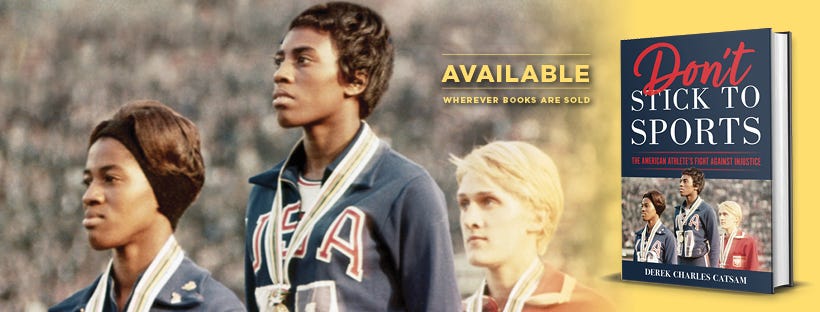
.[Utter shamelessness at work.]
Along these lines, some of the views of Byron de la Beckwith, who assassinated Medgar Evers, are becoming more mainstream. I’m working on a book in which Evers and his murder feature prominently. This is not the legacy that I hope lingers from that terrible June 1963 event.
To end on a lighter note, how about a couple of clever pieces from McSweeney’s Internet Tendency? In this one we have “A Letter to the Parents that Gave My Son Charlie a Bunch of Rocks for Halloween.” And here we have “Cormac McCarthy’s The Mall.” Even our humor these days is somewhat dystopian.
About the Music: Like most people of a certain age, Creedence Clearwater Revival was part of that larger backdrop of classic rock that we just took for granted and then, if we moved on to other genres, or simply continued to embrace new music, Creedence became one of those bands you wouldn’t seek out but wouldn’t turn off if they came on either. And of course it became an immutable law of Hollywood that any Vietnam-era movie was contractually required to feature “Fortunate Son” on its soundtrack.
A while back, though I read Ellen Willis’ Out of the Vinyl Deeps, a collection of her rock criticism, and one of the two bands whose praise stood out the most was that for Creedence (the other was The Who, whose excellence I recognize but have never, I have to admit, fully appreciated). For my birthday last month, I got a gift card that allowed me to buy some vinyl albums, and one of the two that I picked out was Credence’s Chronicle, a greatest hits album with 20 songs on two discs. It really is great rootsy rock-and-roll, swampy and stompy and bluesy and compelling. They were part of a San Francisco scene that they sounded nothing like and front man John Fogerty was their engine and driving force, with a great rock-and-roll voice and serious songwriting chops.
I’m usually not a “Greatest Hits” guy. I like albums, with coherent visions caught in a particular point in time. But I already have several thousand cds and on top of that plenty of downloads. I’m not replicating a serious vinyl collection at this point, especially when buying cds and downloading them to digital will always be my preferred approach. But given this caveat, if you have forgotten how good Creedence was, how great a songwriter Fogerty was, and want a reminder of how there was a lot more to the late 60s-and-early -70s than the Beatles-and-Stones, this is a damned great place to start. GRADE: A